Key takeaways
- Start with how much you can spend, either your spending capacity or whether your savings can support the spending you want.
- A set monthly transfer from a central cash account gives you a predictable paycheck, much like one from an employer.
- Tax planning decides which accounts refill that cash account, from required withdrawals and IRA distributions to capital gains and Roth money.
When you stop working, the paycheck stops too. Retirement income planning is about replacing it, and it comes down to two questions: how much can you spend, and where should each dollar come from?
Step 1: How Much Can You Spend?
There are two ways to approach this, and both lead to the same place:
- What is your spending capacity? Based on Social Security, any pensions, and your investments, how much can you comfortably spend each year? When you claim Social Security plays a big part; see when to claim Social Security.
- How much do you want to spend, and can your savings support it? Start with the retirement you have in mind, then test whether your portfolio can sustain it over a long retirement.
Either way, the result is a spending amount you can feel confident about. From there, we use a guardrails approach. We monitor your portfolio, and if it grows meaningfully, we review whether your spending can increase. If markets fall sharply, there are guardrails on the other side. Portfolios also contain a fixed income allocation that provides stability and peace of mind for when markets are volatile.
Step 2: A Paycheck You Can Count On
Once you know how much you need, the next step is making it predictable. We use a central cash account that sends a set amount to your checking account every month, or on the schedule you prefer, much like a paycheck from an employer. You know what is arriving and when, without deciding what to sell each month. Behind the scenes, we keep that cash account topped up.
If you already receive Social Security or a pension, or will in the future, we factor that in. Those payments come to you directly, and your paycheck from savings covers the difference between them and what you plan to spend, adjusting when they begin.
Bridging the years before Social Security or a pension
If you retire before Social Security or a pension begins, there may be several years with no steady income coming in. Depending on how your savings are set up, we may build a bond ladder, typically using target maturity bond funds. Each fund holds bonds that mature in a particular year, so the ladder provides money for each of those years, feeding the cash account that funds your paycheck. That way, spending in the gap years doesn't depend on selling investments when markets are down.
A paycheck that adjusts with your life
Your paycheck isn't set once and fixed for life. Needs and wants change, and the plan changes with them. Some people find they need less, so the paycheck comes down. Others want to spend more in the early years of retirement, so we plan for that.
Larger expenses work the same way. If you know one is coming, such as a new roof or a family wedding, we can set the money aside ahead of time. And if something comes up on short notice, like a last-minute trip to Antarctica, we can plan around that too, as long as your plan can support it. It's an ongoing conversation, and we work through these decisions together.
Step 3: Where the Money Comes From
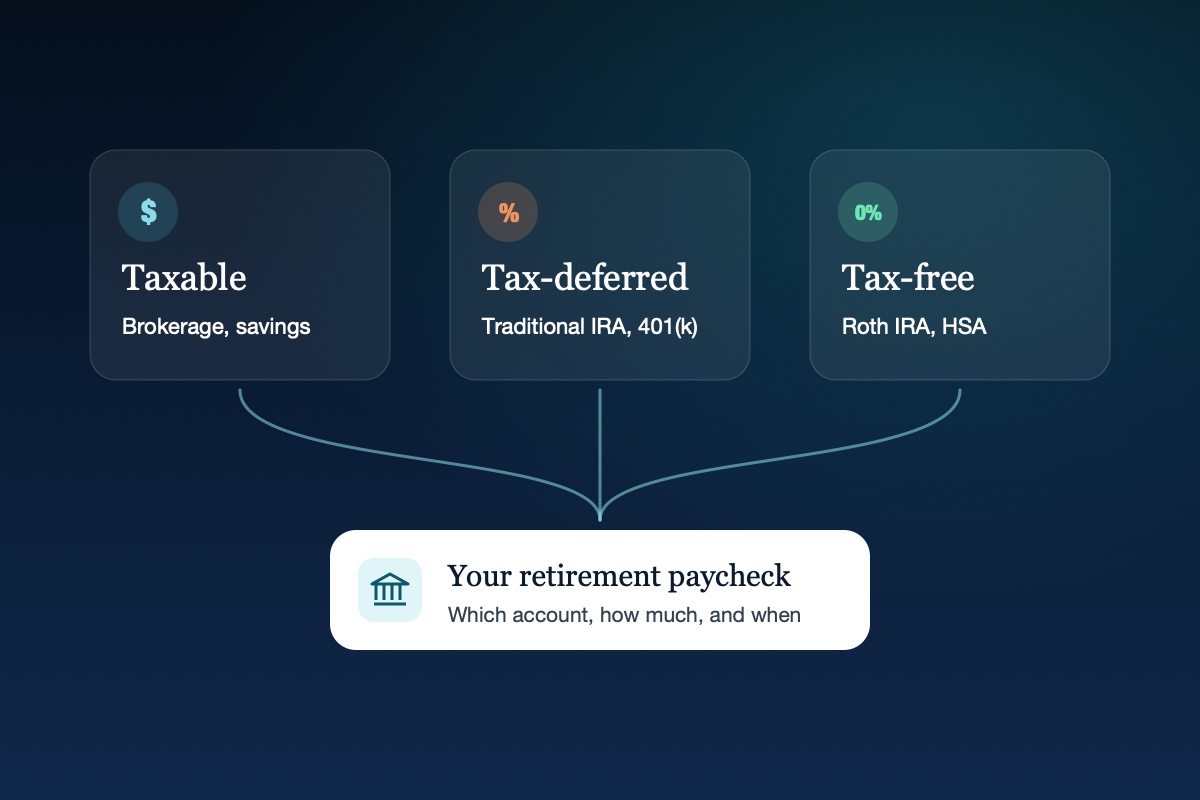
Refilling the cash account is where tax planning comes in, because different accounts are taxed differently when you withdraw:
| Account type | Examples | When you withdraw |
|---|---|---|
| Taxable | Brokerage accounts, savings | Only the growth is taxed, often at lower capital gains rates |
| Tax-deferred | Traditional IRA, 401(k) | Every dollar is taxed as income, and withdrawals become required later |
| Tax-free | Roth IRA | Qualified withdrawals are tax-free |
The questions we work through when deciding where to draw from:
- Are required minimum distributions already in place? If so, they go into the cash account first, since they have to come out anyway.
- What could future RMDs look like, and will they exceed what you need? Large traditional IRA balances can mean large required withdrawals later, on top of Social Security.
- If so, should we take more from IRAs now? Drawing extra while there is room in lower tax brackets this year can reduce the balance, and the taxable withdrawals, in future years. See Roth conversions in early retirement for a related strategy.
- Does it make sense to realize some capital gains? Drawing from a taxable brokerage account can be tax-efficient, since only the growth is taxed.
- Are we close to the next tax bracket? Drawing from a Roth account adds no taxable income, which can help avoid a higher bracket, more tax on Social Security, or higher Medicare premiums through IRMAA.
These decisions are revisited throughout the year as your income and the tax rules change, so the paycheck stays steady while the sources behind it adjust.
Paying the taxes. How taxes are paid depends on where the money comes from and the strategy for the year. When funds come from an IRA distribution, federal and state taxes can be withheld directly from it. In other situations, such as realizing capital gains or doing a Roth conversion, estimated tax payments may make more sense.
What You Experience, and What Happens Behind the Scenes
From your side, retirement income should feel simple: your retirement paycheck arrives consistently each month, or on whatever schedule you choose, and you get on with enjoying retirement with relaxed confidence. Behind the scenes, we take care of the work that keeps it that way:
- Refilling the cash account using the tax decisions above.
- Keeping the right mix of investments for your income needs and comfort with risk, and rebalancing as markets move.
- Holding each investment in the right type of account, known as asset location, so more of your returns can grow in tax-advantaged accounts.
- Using tax-efficient ETFs in taxable accounts, which generally distribute fewer taxable capital gains than many mutual funds.
- Monitoring your plan and portfolio, and adjusting as markets, tax rules, and your life change.
Learn more about our retirement income planning and investment management.
Frequently Asked Questions
How much can I safely spend in retirement?
It depends on your savings, Social Security, any pensions, your expenses, and how long your money needs to last. Rather than a fixed rule, we set a spending level you can feel confident about, then use a guardrails approach: if your portfolio grows meaningfully, we review increasing your spending, and if markets fall sharply, there are guardrails for adjusting the other way.
Which account should I withdraw from first?
There is no single right order. It depends on whether there is room in your lower tax brackets this year, whether large required withdrawals are likely to raise your income later, and how close you are to the next tax bracket or Medicare premium tier.
Do I have to spend my required minimum distributions?
No. Required minimum distributions must be withdrawn from traditional accounts each year, but you don't have to spend them. Any amount you don't need can be saved or reinvested in a taxable account.

James is the founder of IronFjord Wealth Management, a flat-fee fiduciary firm focused on retirement planning, investment management, and tax planning. He works with pre-retirees and retirees to help them make thoughtful, coordinated decisions around their money with clarity and confidence.
More about JamesImportant information about this article
The content on this blog is provided for informational and educational purposes only. It doesn't constitute tax, financial, investment, or legal advice, and it shouldn't be relied upon as such. While we do our best to ensure accuracy and keep information current, no information on this blog should be assumed to be error-free. Tax laws, investment regulations, and financial planning rules change frequently, and this content reflects our understanding as of the date of publication and may not reflect subsequent changes or developments. Nothing you read here should be the basis for any financial or tax decision without first consulting a qualified professional who understands your complete financial situation, goals, and applicable state and federal laws. IronFjord Wealth Management has no knowledge of your individual circumstances and is not responsible for any actions taken based on the content of this blog. Reading this blog or engaging with IronFjord Wealth Management's content does not create an advisory relationship. Any discussion of investment strategies or tax planning approaches reflects general concepts and may not be appropriate for your situation. Where links to third party content are provided, they are for convenience only. IronFjord Wealth Management is not responsible for the accuracy, completeness, or reliability of any third party content. If you have questions about your specific circumstances, we'd encourage you to speak with a qualified financial advisor, tax professional, or attorney.